
Offshore gambling about to flourish in the UK
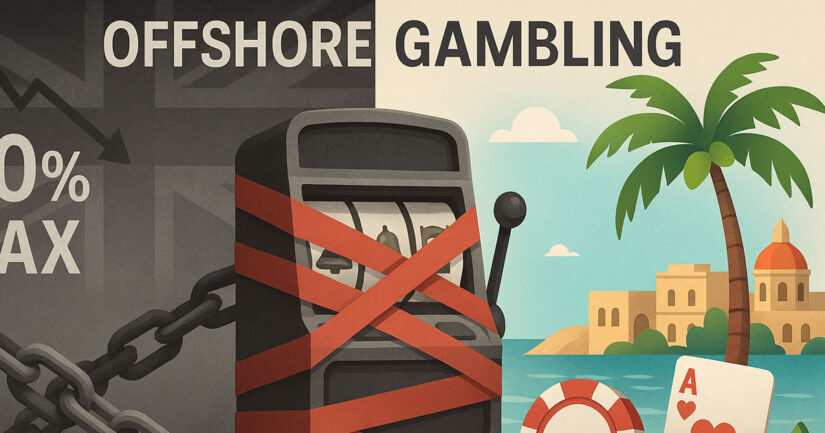
The UK government just doubled the tax on online casinos. From April 2026, Remote Gaming Duty rises from 21% to 40% (yikes). This is by far the steepest increase in British gambling history.[1] Online betting duty will take effect in 2027, rising from 15% to 25%.[1]
Chancellor Rachel Reeves expects this to raise £1.1 billion by 2030.[2] What she hasn’t mentioned is that the Netherlands tried almost exactly this approach in January 2025. Within six months, tax revenue had collapsed, the black market had overtaken the legal market, and the Dutch regulator was publicly stating the policy had failed.[3]
For UK players, this creates a straightforward choice. Accept lower RTPs, reduced bonuses, and a worse product from licensed operators or explore the offshore gambling alternatives that have quietly become the smarter option.
What the budget actually means for players
The Office for Budget Responsibility, the government’s own fiscal watchdog, published a remarkably honest assessment of what happens next. They estimate that operators will pass approximately 90% of the tax increase directly to players through reduced payouts and higher prices.[2]
In practical terms, this means:
- Lower RTPs on slots: Providers like Pragmatic Play and Play’n GO offer multiple RTP versions of the same games (96%, 94%, 92%). UK operators will select the lower-paying versions to maintain margins.[4]
- Reduced or eliminated bonuses: Welcome offers, free spins, and reload bonuses cost operators money. With tighter margins, these disappear first.
- Worse odds on sports betting — the 25% betting duty means bookmakers have less room for competitive pricing.
The OBR projects that Gross Gambling Yield will fall by £500 million by 2029/30 as players either reduce activity or move elsewhere.[2] They explicitly acknowledge this includes “potential substitution to the illicit market.”[2]
This is where offshore gambling enters the picture. Not as some shadowy alternative, but as the rational response to a policy that makes UK-licensed platforms objectively worse value.
The Netherlands did it – This happened
In January 2025, the Dutch government raised the gambling tax from 30.5% to 34.2%. This is a way more modest increase than the UK’s 19 percentage point jump. The Ministry of Finance expected to collect an additional €202 million annually.[3]
Six months later, the Kansspelautoriteit (KSA), the Dutch gambling regulator, published its impact assessment. Did they manage to collect more money? No! The results were catastrophic:[3][5]
| Metric | Netherlands result | UK projection |
|---|---|---|
| Tax increase | +3.7 percentage points | +19 percentage points |
| Expected additional revenue | €202m per year | £1.1bn by 2030 |
| Actual GGR change (H1) | -25% vs prior year | -£500m projected by 2029/30 |
| Tax revenue vs prior year | 83% (€200m+ shortfall) | Unknown |
| Legal market channelisation | Fell from 58% to 50% | Currently ~95% |
| Illegal market GGR (H1 2025) | €617m (surpassed legal market) | Currently ~5% of market |
Sources: KSA Impact Assessment August 2025, KSA 9th Monitoring Report November 2025, VNLOK trade body data via Financieele Dagblad
A financially driven measure such as gambling tax is contrary to the policy objective of providing players with more protection. If we want to be able to offer players a protected gaming environment in the future, a financially healthy legal market is essential.[3]
KSA Chairman Michel Groothuizen
The unlicensed offshore gambling market in the Netherlands now generates more revenue than the legal sector. €617 million versus €600 million in H1 2025, according to the KSA’s own monitoring report.[6] Instead of raising €200 million, the Dutch government faces a €263 million shortfall.[6]
The UK is implementing a tax increase more than five times larger. The arithmetic is not complicated.
France and Sweden: the same story, different countries
The Netherlands isn’t an isolated case. Across Europe, aggressive gambling taxation has consistently produced the same outcome: players migrate to offshore gambling platforms that offer better value.
In France, 5.4 million players now use unlicensed sites compared to 3.5 million on legal platforms. Thats a 35% surge in just two years.[7] The illegal market generated €2 billion in GGR in 2025, causing an estimated €1.2 billion in annual fiscal losses.[7] The black market accounts for 57% of all money staked.[7]
Sweden’s online casino channelisation has dropped to an estimated 72-82%, described as “catastrophic” by industry body BOS.[8] For comparison, Denmark, which has more liberal regulations, maintains 90% channelisation.[8] Traffic to unlicensed offshore gambling sites in Sweden has increased tenfold since 2019.[8]
A PwC study covering 2019-2024 found that countries with gambling tax rates below 25% of GGR saw 13% annual growth in tax receipts, versus only 9% for high-tax jurisdictions.[9] Higher taxes don’t generate more revenue. What they do instead is push players toward offshore gambling alternatives.
Once they’re gone, they’re gone
The damage from tax increases isn’t just immediate — it’s permanent. Once operators restructure their businesses around offshore jurisdictions, they don’t return.
Flutter, owner of Sky Bet, Paddy Power, and Betfair, has already relocated Sky Bet’s headquarters from London to Malta. The company confirmed this will save approximately £55 million annually in UK tax payments.[10]
This isn’t a threat or a negotiating tactic. It’s a completed transaction. Even if the UK reversed its tax policy tomorrow, Sky Bet’s operations are now structured around Malta. The jobs, the tax revenue, and the corporate infrastructure have left permanently. IT’S GONE!
Other operators are watching closely. The calculus is simple: pay 40% tax in the UK, or pay 0.5-5% in Malta.[11] Curaçao offers a 2% corporate tax rate on gambling profits.[12] Gibraltar has historically provided similarly competitive terms.
Industry analyst Alun Bowden warned that a 35% tax rate would make the UK market “unprofitable for most operators.”[13] The government went to 40%.
The offshore gambling alternative
Here’s what offshore gambling platforms actually offer compared to their UK-licensed counterparts:
- The same games from the same providers. Pragmatic Play, Play’n GO, NetEnt, Evolution Gaming — all the major software providers supply both UK-licensed and offshore operators. The slots and live casino games are identical.[4]
- Higher RTPs. Game providers offer multiple RTP versions. While UK operators under margin pressure select 92-94% versions, offshore gambling sites can offer the 96%+ versions. Over thousands of spins, this difference is substantial.[4]
- Better bonuses. Without 40% tax eating into margins, offshore operators can afford generous welcome offers, reload bonuses, and loyalty programmes that UK sites are cutting.
- No stake limits or affordability checks. UK regulations increasingly restrict how much players can wager and require invasive financial checks. Offshore gambling platforms operate without these constraints.
- Cryptocurrency options. Many offshore sites accept Bitcoin, USDT, and other cryptocurrencies. These offer quick deposits, fast withdrawals, and additional privacy.[12]
- No deposit limits. The Netherlands introduced strict deposit limits as part of its regulatory tightening. The KSA’s own data shows this was a primary driver of players moving to offshore gambling sites.[5]
The jurisdictions hosting these operators like Malta, Curaçao, Gibraltar and Isle of Man, aren’t unregulated wildcats. Malta was the first EU member state to regulate online gambling and maintains a rigorous licensing framework through the Malta Gaming Authority.[14] These are established jurisdictions that see the UK’s tax policy as a business opportunity.
What’s the actual risk for players?
UK law targets operators, not players. There is no criminal liability for using offshore gambling sites unless the activity involves money laundering or other underlying criminal purposes.[15]
The practical trade-off is the loss of UK-specific consumer protections:
- No access to the UK Gambling Commission’s dispute resolution mechanisms
- No coverage under UK self-exclusion schemes like GamStop
- Complaints would need to go through the operator’s licensing jurisdiction
For most players, these protections have limited practical value. The overwhelming majority of gambling activity proceeds without disputes. For those who do encounter issues, regulators like the Malta Gaming Authority maintain their own complaint procedures.
The UK Gambling Commission hasn’t commented directly on the tax changes, though their timing is notable. Just yesterday, they signed a joint declaration with European regulators warning that “illegal online gambling undermines the entire regulatory framework designed to protect the public interest.”[16]
The statement was aimed at genuinely illegal operators — unlicensed sites with no regulatory oversight. It wasn’t addressing licensed offshore gambling platforms operating legally under Malta, Gibraltar, or Curaçao jurisdiction. The distinction matters.
The bottom line
The UK government has made a bet. They’re betting that players will accept worse RTPs, reduced bonuses, and a diminished product rather than explore alternatives. They’re betting that despite overwhelming evidence from the Netherlands, France, and Sweden, British punters will behave differently.
The OBR’s own projections suggest this bet will lose. They expect a £500 million drop in GGR and explicitly model player migration to the “illicit market.”[2]
For players, the calculation is straightforward. From April 2026, every spin on a UK-licensed slot will return less money. Every sports bet will offer worse odds. Every first deposit bonus will be smaller or non-existent.
Offshore gambling platforms offer the same games with better returns. The legal risk to players is effectively zero. The only question is whether you’re paying attention.
References
- HM Treasury, “Changes to Gambling Duties,” GOV.UK, 26 November 2025. https://www.gov.uk/government/publications/changes-to-gambling-duties
- Office for Budget Responsibility, “Economic and Fiscal Outlook,” November 2025. Leaked document confirmed operators expected to pass 90% of costs to consumers, with GGY projected to fall by £500m by 2029/30.
- Kansspelautoriteit (KSA), Impact Assessment on gambling tax increase, August 2025. Reported via Gaming Intelligence, 6 August 2025. https://www.gamingintelligence.com/finance/217746-dutch-gambling-market-sees-drop-in-tax-revenue-after-tax-increase/
- Industry reporting on RTP adjustments by operators following tax changes. Multiple sources including VideoSlots confirmation of RTP modifications for Pragmatic Play, Play’n GO, Red Tiger Gaming, and IGT games.
- VNLOK (Licensed Dutch Online Gambling Providers) trade body data, reported via Financieele Dagblad, August 2025. Confirmed 25% GGR decline in H1 2025 versus H1 2024.
- Kansspelautoriteit (KSA), 9th Monitoring Report, November 2025. Confirmed illegal market GGR of €617m exceeded legal market GGR of €600m in H1 2025. Reported via Tribuna.com, 17 November 2025. https://tribuna.com/en/casino/news/2025-11-17-gambling-industry-urges-dutch-parlamient-to-halt-2026-tax-rise-as-illegal-market-overtake/
- French black market statistics from multiple industry sources tracking unlicensed gambling activity in France, 2023-2025.
- BOS (Branschföreningen för Onlinespel), Swedish online gambling industry body, channelisation estimates 2024-2025.
- PwC study on gambling taxation and revenue growth across European markets, 2019-2024 data analysis.
- Flutter Entertainment plc, confirmation of Sky Bet headquarters relocation to Malta. Multiple sources including CasinoBeats, 26 November 2025. https://casinobeats.com/2025/11/26/uk-budget-2025-leak-shows-gambling-tax-increases/
- Malta Gaming Authority tax rates. Corporate tax at 35% with foreign shareholder refunds effectively reducing rate to 0.5-5% of GGR depending on structure. Source: KPMG Malta Gaming Report.
- Curaçao e-Gaming licensing and tax structure. Corporate tax rate of 2% on net gambling profits. Source: Faisal Khan, “Global Offshore Gambling and Financial Services,” October 2024. https://faisalkhan.com/2024/10/17/global-offshore-gambling-and-financial-services-a-deep-dive-into-curacao-and-similar-jurisdictions/
- Alun Bowden, industry consultant, LinkedIn commentary on UK gambling tax impact, August 2025. Reported via Canyon News. https://www.canyon-news.com/uk-gambling-industry-on-alert-as-tax-changes-threaten-profits/
- Malta Gaming Authority regulatory framework. Malta was the first EU member state to regulate online gambling. Source: Baltic Times, “Why Are There So Many Offshore Gambling Sites In Malta and Curacao?” https://www.baltictimes.com/why_are_there_so_many_offshore_gambling_sites_in_malta_and_curacao_/
- UK gambling law — players face no criminal liability for using offshore operators. Operators targeting UK customers without UKGC licence are in violation; players are not prosecuted. Multiple legal sources.
- UK Gambling Commission, joint declaration with European regulators (Austria, France, Germany, Italy, Portugal, Spain) on illegal online gambling, 25 November 2025. https://www.gamblingcommission.gov.uk/